| | |

CAR T-Cell Therapy for Mesothelioma in New Phase I Trial
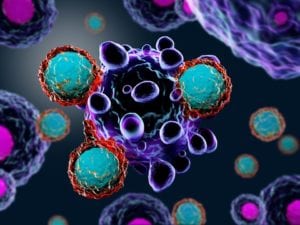
CAR T-Cell Therapy for Mesothelioma

Researchers at Memorial Sloan Kettering in New York are about to try a new kind of CAR T-cell therapy for mesothelioma in human patients. 

This is the first Phase I trial of the new CAR T-cell approach. The therapy involves removing some of a patient’s T-cells, modifying them, and giving them back to fight cancer. 

The new CAR T-cell therapy for mesothelioma involves cells that have been modified in new ways. They still seek out cancer cells. But these CAR T-cells are made to last longer and to undermine a primary mesothelioma cell defense mechanism.

The FDA approved the study in September. Memorial Sloan Kettering is recruiting mesothelioma patients for it now. 

T-Cells That Target Mesothelioma Cells

CART T-cell therapy for mesothelioma is a type of immunotherapy. It starts with T-cells from the patient’s blood. Scientists alter the cells to recognize certain antigens on the surface of cancer cells. Then they give them back to the patient.

In the case of mesothelioma, the main targeted antigen is mesothelin. Mesothelioma patients tend to produce extra mesothelin. This protein helps drive the growth and spread of their cancer. People with high levels of mesothelin stand to benefit the most from CAR T-cell immunotherapy. 

The new CAR T-cell therapy for mesothelioma uses cells that are engineered to last longer before they die out. It also acts on another protein called PD-1. PD-1 helps keep the immune system from kicking into overdrive when it detects an invader. 

But when that invader is cancer, an active immune system is a good thing. Many mesothelioma patients produce extra PD-1. The new approach blocks this so that the CAR T-cells can do their job better. It is the first CAR T-cell treatment to combine long-living cells and PD-1 blocking. 

First Trial of the New CAR T-cell Therapy for Mesothelioma

Atara Bio makes the new CAR T-cell therapy for mesothelioma. They call it ATA2271. They developed the treatment in collaboration with Memorial Sloan Kettering researchers

The new trial will test it in mesothelioma patients for the first time. Mesothelioma patients are a critical group. They have fast-growing cancer on the lining around their lungs and few good treatment options. The FDA approved CAR T-cell treatment for people with some blood cancers. Atara Bio hopes their version will be the first to win approval for mesothelioma.

“This milestone marks an important moment in the advancement of cell and gene immunotherapy for patients, for the field, and for Atara,” says Jakob Dupont, Global Head of Research and Development at Atara Biotherapeutics.

To be in the study, pleural mesothelioma patients must have failed with other treatments.. They also cannot have tried CAR T-cell therapy for mesothelioma before. They must be healthy enough to do most of their daily activities. 

Patients will start by giving some blood. They will get a dose of a chemotherapy drug called cyclophosphamide. Then, the modified cells will go directly into the pleural space around the lungs. They are delivered through a pleural catheter. 

A Phase I trial is mainly to test safety. Future trials will test the effectiveness of the treatment and establish the best dose.

Sources:

“A Phase I Study of CAR T-Cell Immunotherapy for Pleural Mesothelioma”, Memorial Sloan Kettering website, https://www.mskcc.org/cancer-care/clinical-trials/20-328

“Atara Biotherapeutics Announces FDA Clearance of IND for ATA2271, a Next-Generation Autologous Mesothelin-Targeted CAR T with Novel PD1DNR and 1XX Technologies Combined to Treat Solid Tumors”, September 8, 2020, Alarta Bio news release, https://investors.atarabio.com/news-events/press-releases/detail/205/atara-biotherapeutics-announces-fda-clearance-of-ind-for

Mesothelin-targeted CAR T-cell Therapy in Patients With Mesothelioma, Clinical Trial website, https://clinicaltrials.gov/ct2/show/NCT04577326

Similar Posts

  • | |

    Doctors Describe "Concrete Therapeutic Approach" for Mesothelioma

    A team of medical researchers in Italy have achieved what they are calling “excellent” tumor control and survival results in malignant pleural mesothelioma patients using a combination of surgery, chemotherapy, and radiotherapy. Caused by exposure to asbestos, mesothelioma typically spreads quickly across the lung-encasing membrane called the pleura. There is no known cure but treatments are improving. In the current prospective study, 20 malignant pleural mesothelioma patients underwent radical pleurectomy/decortication followed by high doses of radiation. After surgeons removed as much of the visible mesothelioma tumor and surrounding tissue as possible, patients received 50Gy of radiation to the effected side of their chest, delivered in 25 fractions. Regions of particular concern for mesothelioma regrowth got an extra radiation “boost” to…

  • | |

    Does Radiotherapy Reduce Mesothelioma Pain?

    A new study says there is not enough evidence to support the use of radiotherapy for the treatment of pain associated with malignant pleural mesothelioma. Researchers at the University of Edinburgh in Scotland reviewed a range of past studies on mesothelioma pain and radiotherapy by searching databases that date back as far as 1974. To be eligible to be included in their review, the study had to focus on malignant pleural mesothelioma and radiotherapy given “with the intent of improving pain”. The study also had to report doses and fractionation of the radiotherapy and how the pain responded. In all, the researchers found eight studies on mesothelioma pain and radiotherapy that met the criteria. Two of the studies were prospective…

  • |

    Ape Virus Shrinks Mesothelioma Tumors in Lab

    A virus that causes leukemia in gibbon apes may have the power to help fight malignant mesothelioma in people. Gibbon ape leukemia virus (GALV) has been tested for years as a viral vector, a carrier of therapeutic genetic information, in the treatment of various human illnesses, including cancer. A new study in Japan compared GALV with a leukemia virus derived from mice to see which carrier communicated most efficiently with mesothelioma cells. While both types of viruses replicated in most of the mesothelioma cell lines tested, the mouse-derived virus was not effective in a mesothelioma cell line called ACC-MESO-1. In this cell line, only the GALV spread efficiently both in culture and in mice that had been given human mesothelioma…

  • | |

    Radiotherapy for Mesothelioma: Better But Still Limited

    A form of highly-targeted radiation therapy for mesothelioma is better than it used to be, but is still risky. That is the message of a recent article on intensity-modulated radiation therapy (IMRT) in Seminars in Thoracic and Cardiovascular Surgery. Author Kenneth E. Rosenzweig, MD, a Radiation Oncologist with Mount Sinai Hospital in New York, reviewed recent studies on IMRT and mesothelioma. He concludes that, while the “troubling toxicity” associated with IMRT when it was first introduced has not been entirely eliminated, the fact that clinicians now have more experience with it is making a positive difference for mesothelioma patients. Before targeted therapies like IMRT were available, high-dose radiation was not usually a feasible option for mesothelioma since the irregular shape…

  • | |

    A Second-Line Option for Mesothelioma?

    Although survival was not significantly extended, the chemotherapy drug vinorelbine might be a treatment option for mesothelioma patients whose cancer has returned after first-line chemotherapy with pemetrexed. A new study on vinorelbine as a second-line treatment finds that the drug is “moderately active” in mesothelioma patients who were initially treated with pemetrexed-based chemotherapy. Pemetrexed (Alimta), along with a platinum-based drug like cisplatin, is the primary first-line drug therapy for mesothelioma. But vinorelbine is gaining attention as a possible option for mesothelioma, in part because it is available in a less expensive generic form. In “Vinorelbine in pemetrexed-pretreated patients with malignant pleural mesothelioma”, the Italian authors detail the results of their study on 59 patients with unresectable pleural mesothelioma.  These patients…

  • | |

    Repeat HIPEC Improves Mesothelioma Survival

    If one cytoreductive surgery and HIPEC procedure for mesothelioma is good, subsequent treatments may be even better. That is the central message of research conducted at the Moffitt Cancer Center in Florida. The study’s aim was to assess overall survival among peritoneal mesothelioma patients who had not just one, but two or more rounds of heated intraperitoneal chemotherapy (HIPEC) after cytoreductive surgery. The cytoreduction/HIPEC approach has become popular for peritoneal mesothelioma, a treatment-resistant cancer of abdominal membranes caused by asbestos. Cytoreductive surgery involves removing as much of the mesothelioma tumor as possible from the abdomen. Because the shape and spreading pattern of mesothelioma tumors make complete cytoreduction difficult, the surgery is often followed by a rinse with a heated solution…