| |

COVID-19 Vaccine May Help Mesothelioma Survivors Avoid Serious Side Effects
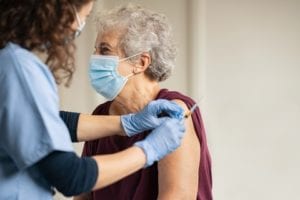
COVID-19 VaccineSeveral new studies illustrate the importance of the COVID-19 vaccine for malignant mesothelioma patients and survivors. They suggest that people with mesothelioma would do well to find out the rules for vaccination in their state. 

In one study, cancer patients who contracted the SARS-CoV-2 (COVID) infection developed serious neurologic symptoms. These symptoms are rarely seen in healthy people who get the illness. 

Another study showed cancer survivors were more likely to get severely ill or die from SARS-CoV-2. The study says this is because they tend to have more underlying medical conditions

An article published in Cancer Discovery found that people with cancer die of SARS-CoV-2 at a rate twice as high as those without cancer. 

The COVID-19 vaccine may offer some protection for mesothelioma patients. But the decision has to be made on an individual basis. Mesothelioma patients should discuss the pros and cons of vaccination with their doctor. 

NCI: Mesothelioma Patients Should Get Prioritized for COVID-19 Vaccine

The study of underlying medical conditions appears in a recent issue of the Journal of the National Cancer Institute. Researchers surveyed 6,411 cancer survivors and 77,748 healthy adults. 

They found that cancer survivors were 56 percent more likely to have one or more underlying medical conditions. They were 23 percent more likely to have two or more.The research team concludes that cancer survivors should be at the front of the line for the COVID-19 vaccine. 

“Survivors of cancer remain particularly vulnerable and should be prioritized in COVID-19 vaccination campaigns,” writes lead author Changchuan Jiang, MD, MPH.

Unfortunately, that may not be as easy as it sounds for mesothelioma survivors. The rules about who can get the COVID-19 vaccine are different in every state. 

Neurological Problems in Cancer Patients with SARS-CoV-2

A study published in Cancer Cell says cancer patients who get SARS-CoV-2 may experience severe neurological problems. The study included cancer patients who had treatment within 30 days of getting sick with COVID. 

Many people who get the coronavirus have headaches and lose their senses of smell and taste. But for people with pleural mesothelioma and other types of cancer, neurological problems can go much deeper. 

In the study, many had delirium, seizures, and swelling of the brain. Researchers found inflammatory markers in the spinal fluid of cancer patients weeks after their infection. 

“These prolonged neurologic sequelae following systemic cytokine release syndrome lead to long-term neurocognitive dysfunction,” writes author Jan Remsik of Memorial Sloan Kettering Cancer Center in New York. “Our findings suggest a role for anti-inflammatory treatment(s) in the management of neurologic complications of COVID-19 infection.”

Mesothelioma patients who want to know more about the COVID-19 vaccine should call their oncologist. Some states do prioritize cancer patients and survivors as well as older adults. Mesothelioma is most common in people over 65. 

Sources:

Remsik, J, et al, “Inflammatory Leptomeningeal Cytokines Mediate COVID-19 Neurologic Symptoms in Cancer Patients”, February 8, 2021, Cancer Cell, https://www.cell.com/cancer-cell/fulltext/S1535-6108(21)00051-9#%20

Jiang, C, et al, “Prevalence of Underlying Medical Conditions Associated with Severe COVID-19 Illness in Adult Cancer Survivors in the United States”, February 3, 2021, Journal of the National Cancer Institute, https://academic.oup.com/jnci/advance-article/doi/10.1093/jnci/djab012/6123751

Mehta, V, “Case Fatality Rate of Cancer Patients with COVID-19 in a New York Hospital System”, July 2020, Cancer Discovery, https://cancerdiscovery.aacrjournals.org/content/10/7/935


Similar Posts

  • |

    Ape Virus Shrinks Mesothelioma Tumors in Lab

    A virus that causes leukemia in gibbon apes may have the power to help fight malignant mesothelioma in people. Gibbon ape leukemia virus (GALV) has been tested for years as a viral vector, a carrier of therapeutic genetic information, in the treatment of various human illnesses, including cancer. A new study in Japan compared GALV with a leukemia virus derived from mice to see which carrier communicated most efficiently with mesothelioma cells. While both types of viruses replicated in most of the mesothelioma cell lines tested, the mouse-derived virus was not effective in a mesothelioma cell line called ACC-MESO-1. In this cell line, only the GALV spread efficiently both in culture and in mice that had been given human mesothelioma…

  • | |

    Micro-RNAs May Offer New Way to Fight Mesothelioma

    Scientists at one of the world’s top mesothelioma research centers, the Asbestos Diseases Research institute in Sydney, Australia, say that restoring the expression of certain micro RNAs in the cells of mesothelioma patients may offer a new way to fight the disease. A microRNA is a small RNA molecule which is involved in the regulation of gene expression. According to a new report in the Annals of Oncology, the Australian scientists found reduced expression of the micro RNA-15 family (miR-15/16) in the cells of mice with mesothelioma. “When malignant pleural mesothelioma cell lines were compared with the normal mesothelial cell line MeT-5A, the downregulation of miR-15/16 was 2- to 10-fold,” they report. This finding is consistent with previous cancer research…

  • |

    Mesothelioma Still Carries Heavy Mortality Burden in U.S.

    Asbestos exposure cost Americans more than 427,000 years of potential life in the first decade of the new millennium. That figure comes from a study on mesothelioma and asbestosis – the two most deadly asbestos-related diseases – conducted by the CDC’s National Institute for Occupational Safety and Health (NIOSH). Using National Center for Health Statistics mortality data, NIOSH researchers evaluated premature deaths and “loss of potentially productive years of life” attributable to either asbestosis or mesothelioma between 1999 and 2010. The data included only people 25 years or older with an underlying cause of death listed on their death certificate of either asbestosis or malignant mesothelioma. When the figures were calculated using the normal life expectancy for each asbestosis victim…

  • | |

    Treatment Uses Herpes Virus to Shrink Mesothelioma Tumors

    Researchers at a hospital in Sheffield, England are testing a potential new mesothelioma treatment based on the same virus that causes herpes. The small-scale trial is the first in the world to test the modified herpes simplex virus, HSV1716, in human mesothelioma patients. HSV1716 has been genetically engineered to infect and kill cancer cells without harming healthy cells. In laboratory studies on mesothelioma and some other cancers, it has been shown to be effective at shrinking tumors while causing limited toxicity. Just as significantly, HSV1716 increased survival rates among mice with various human cancers. The Phase I/II trial at Sheffield Experimental Cancer Medicine Centre is the next stage in development of HSV1716 as a viable mesothelioma treatment. The goal of…

  • | |

    New Mesothelioma Drug Kills Cancer Stem Cells

    Citing “significant enthusiasm within the mesothelioma community”, the manufacturers of a promising new mesothelioma drug say they have begun a major test of the drug in patients. Massachusetts-based Verastem, Inc. focuses on drugs that fight cancer by attacking the stem cells that give rise to them. Earlier this summer, the FDA granted orphan drug status to their stem cell inhibitor, defactinib, for the treatment of mesothelioma. The designation, which is reserved for drugs that fight the rarest of diseases, helps pave the way for testing and faster approval, depending on the results of clinical trials. “Development of a drug that preferentially kills cancer stem cells is a promising approach, as many standard-of-care treatments have been shown to either have no…

  • | |

    Mesothelioma Study Finds New Treatment Target

    Immunotherapy, which involves reprogramming T-cells to find and attack cancer cells, is one of the fastest-growing areas of cancer research. One of the biggest challenges of immunotherapy is how to harness the power of T-cells against cancer without also turning them against healthy cells. A new study conducted in Switzerland and published in the Journal of Translational Medicine addressed the problem by reprogramming T-cells to recognize and attack mesothelioma cells that express a specific protein. Fibroblast Activation Protein (FAP) is expressed on the surface of tumor-associated fibroblast cells which are found in the connective tissue of mesothelioma tumors. FAP is also found in mesothelioma cells and may play a role in the start of cancer, as well as the growth…