| | | |

Prognostic Value of PET/CT in Pleural Mesothelioma Patients
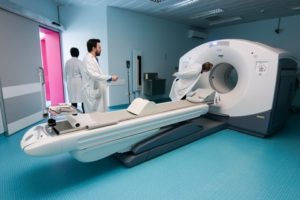
prognostic value of PET/CTNew data highlights the prognostic value of PET/CT scans for patients with malignant pleural mesothelioma.

Pleural mesothelioma is a rare malignancy with a poor prognosis. But some patients tend to do better than others. Scientists are always looking for better ways to predict which patients will respond best to which treatment.

A new Turkish study focused on the prognostic value of scans that measure tumor volume and metabolic activity. They conclude that PET/CT is a valuable way to predict mesothelioma outcomes. Doctors can use the information to help plan for chemotherapy or surgical treatment. 

How PET/CT Scans Work

Doctors have been aware of malignant mesothelioma since the 1930s. That is when it first started appearing among asbestos workers. But there are still many things about mesothelioma that are unknown. 

One mystery is why some asbestos-exposed people get this rare cancer while others do not. Another mystery is why a treatment that works well in one patient does not work as well in another. 

That is why it is important for doctors to know the prognostic value of PET/CT. PET stands for positron emission tomography. It is usually used along with a radioactive tracer (called FDG) to measure the metabolic rate of tumors. The amount of tracer absorbed by a tumor is the maximum standardized uptake volume (SUV). 

CT stands for computed tomography. A CT scan takes multiple X-ray images from different angles. Together, the X-ray images create a 3D picture of internal structures. Doctors can use CT data to measure the volume of a mesothelioma tumor. 

Determining the Prognostic Value of PET/CT

Doctors often use a combined PET/CT to diagnose mesothelioma. But the Turkish researchers say the method has high prognostic value, too. Prognosis is more than a way to predict whether a patient will live or die. It is also an important tool for choosing the right mesothelioma treatment.

The new study included 65 pleural mesothelioma patients. The youngest patient was 39 and the oldest was 84. The group included 34 men and 31 women. The patients had PET/CT (with FDG) for staging between 2008 and 2018. 

Researchers compared the scan results with each patient’s outcome to determine the prognostic value of PET/CT. The average survival time was 17 months. About 35 percent of patients were still alive two years after treatment. Just under 8 percent lived for five years. 

Factors Linked to Mesothelioma Survival

Being older than 60 and having mesothelioma on the left side of the chest were both linked to shorter survival. But the PET/CT scans also proved to have significant prognostic value. People with an SUV of more than 9.8 had shorter survival than those with lower values. 

Those with a total lesion glycolysis (TLG) of more than 180.2 g also lived for a shorter time. Doctors find this number by multiplying the average SUV (PET data) by the tumor volume (CT data). 

“Metabolic parameters of [FDG PET/CT] have the potential to provide prognostic information for malignant pleural mesothelioma patients who are receiving surgery and/or chemotherapy,” writes author Bülent Mustafa Yenigün. A Turkish medical journal published the article.

The prognostic value of PET/CT is one reason that mesothelioma patients should look for an experienced medical center. Larger medical centers tend to have more advanced diagnostic equipment and more experienced doctors. Multiple studies suggest that patients who get mesothelioma treatment at larger cancer centers have the best outcomes. 

Source:

Yenigün, BM, et al, “The prognostic value of 18F-fluorodeoxyglucose positron emission tomography/ computed tomography parameters in patients with malignant pleural mesothelioma”, January 13, 2021, Turkish Journal of Thoracic and Cardiovascular Surgery, January 13, 2021, Online ahead of print, https://www.ncbi.nlm.nih.gov/pmc/articles/PMC7970077/


Similar Posts

  • |

    Mesothelioma Still Rising Despite Ban in Ireland

    A study in Ireland confirms that it can take many years for a ban on asbestos to have a measurable impact on a country’s rates of malignant mesothelioma. Mesothelioma is the most serious of a list of diseases – including lung cancer, pleural plaques, asbestosis, and others – linked with exposure to asbestos dust. Affecting the linings around the lungs and other organs, mesothelioma is often resistant to most cancer treatments and may be fatal within a year of diagnosis. According to the International Ban Asbestos Secretariat, Ireland is one of 55 countries that have enacted some type of asbestos ban. However, although Ireland banned asbestos in 2000, a new study published in Cancer Epidemiology shows that incidence of the…

  • |

    Website Aims to Protect Homeowners from Mesothelioma

    Australia’s Cancer Council is trying to educate home renovators about their risk for mesothelioma with a new e-learning course. Australia has one of the highest per capita rates of mesothelioma in the world, largely because of several asbestos mining operations that were once located there. Although asbestos has been banned from building products in Australia since 1989, asbestos-linked diseases like mesothelioma, lung cancer, and asbestosis continue to pose a serious health concern. While mesothelioma has traditionally occurred among people exposed to asbestos on the job, Australia is now bracing for another “wave” of mesothelioma victims among homeowners who encounter asbestos while doing their own renovation projects. Cancer Council Australia has launched “kNOw asbestos in your home” in an effort to…

  • | | |

    Mesothelioma Nurses Ready for New Cases in Australia

    Australia is bracing for an expected new wave of mesothelioma cases in the next decade and the Lung Foundation of Australia is taking action now to get ready. The Foundation has paid for ten nurses from around the country to receive specialized training in helping patients and families cope with mesothelioma. The nurses, who have recently completed the training, are now equipped to lead treatment planning for these complex cancer patients and to help other nurses do the same. Pleural mesothelioma is an aggressive cancer that occurs in the lining around the lungs. It is caused by exposure to asbestos dust, a toxin that was once alarmingly prevalent in Australia where it was mined and heavily used in construction. Because…

  • |

    Mesothelioma Blood Test May Be Possible

    An international team of researchers is studying the proteins found on the surface of cancer cells in an effort to improve mesothelioma diagnosis. The team, made up of scientists from the US, Switzerland, Italy and Chile, has just published their findings on a new kind of test to identify protein-derived mesothelioma biomarkers in blood serum. Mesothelioma is an aggressive cancer of the membranes around organs. Because the most common mesothelioma biomarker, mesothelin, is also overproduced by other kinds of cancer cells, it has only limited diagnostic value. A test to identify a set of proteins produced specifically by mesothelioma cells could greatly improve diagnostic accuracy. Led by Ferdinando Cerciello and Bernd Wollscheid of the Institute of Molecular Systems Biology in…

  • | |

    Spanish Mesothelioma Deaths Likely to Continue for Decades

    New research in Spain suggests that mesothelioma deaths will continue in the country until the “last surviving member” of the group of people exposed to occupational asbestos succumbs to the disease. Like many countries, Spain used asbestos heavily in the first half of the 20th century, especially in construction, where the mineral was prized for its durability, low cost, and resistance to fire and corrosion.  Asbestos was banned in Spain in 2002. Observing that more than 2.5 million metric tons of asbestos were imported into Spain from 1906 to 2002, researchers say deaths from mesothelioma have risen steadily. Between 1976 and 1980, a total of 491 Spanish people died of mesothelioma. By the 5-year period from 2006 to 2010, that…

  • | |

    Needle Biopsy “Simple, Safe & Accurate” for Mesothelioma

    Mesothelioma researchers in China say a biopsy method that involves a single skin puncture can produce good diagnostic results for mesothelioma patients with little pain or risk. The study focused on percutaneous (through the skin) biopsy in patients who had unexplained fluid buildup or swelling in their abdomens. Abdominal distension and fluid buildup (called ascites) can be signs of peritoneal mesothelioma, a rare but aggressive cancer of the abdominal lining caused by exposure to asbestos. Peritoneal mesothelioma accounts for less than 30% of all mesothelioma cases. Because the symptoms may be vague and often develop many decades after asbestos exposure, peritoneal mesothelioma can be especially challenging to diagnose.  Misdiagnosis and under-diagnosis are not uncommon. In the newest study on percutaneous…