| | | |

Exhaled Breath Analysis: Is it the Future of Mesothelioma Diagnosis?
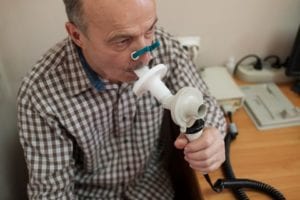
exhaled breath analysis

A new report says there is much for the mesothelioma community to be excited about in the technology known as exhaled breath analysis. 

Several studies suggest the method is as accurate at identifying mesothelioma as some more invasive tests. 

Researchers at the University of Leuven in Belgium led the new study. They analyzed six other studies on exhaled breath analysis

The goal was to see how accurate the method is for diagnosing mesothelioma and other asbestos diseases. The researchers conclude that things look good for exhaled breath analysis, but there is more to learn. 

Searching for Signs of Mesothelioma

Pleural mesothelioma is an aggressive lung-related cancer caused by exposure to asbestos. It can take decades to develop, but once it does, it typically progresses quickly. One reason mesothelioma is so deadly is that most people have few signs of the disease until it is very advanced. 

This is where scientists hope exhaled breath analysis might help. Right now, the only definite way to diagnose mesothelioma is to look at tumor cells under a microscope. Biomarkers found in blood or lung fluid can help confirm the diagnosis. 

Exhaled breath analysis might make it possible to identify mesothelioma faster and earlier. The test itself is quick and easy to administer. And patients might be more likely to get it since there are no needles or scalpels involved.  

Compounds in Exhaled Breath are Key

Cancer causes biochemical changes in the body. These biochemical changes produce volatile organic compounds (VOCs) that a person exhales. 

Different types of cancer produce different combinations of VOCs. Exhaled breath analysis measures these VOCs to see what type of cancer produced them.

The authors of the new meta-analysis searched the medical literature for studies on breath testing for mesothelioma. They found six that met their criteria. The sample sizes in the studies ranged from 39 to 330 people. 

“Some compounds…that can be indicative of malignant pleural mesothelioma development in asbestos exposed population were identified with high diagnostic accuracy rates,” writes lead author Zehra Nur Töreyin.

Some of the studies used e-nose technology which relies on a mesothelioma “breathprint”. This is a combination of VOCs unique to mesothelioma patients. Studies found the e-nose could tell the difference between mesothelioma patients and asbestos exposed people who were not sick. 

The Future of Exhaled Breath Analysis

Exhaled breath analysis does look promising for mesothelioma diagnosis. But it may be some time before scientists will know for sure. 

The research team says the existing studies are too small to apply the results in clinical practice. Also, these studies were all conducted in different ways. This makes it harder to say for sure how well the technology works. 

“More prospective studies with standardized methodologies should be conducted on larger populations,” the researchers conclude. 

Source:

Töreyin ZN, et al, “Exhaled Breath Analysis in Diagnosis of Malignant Pleural Mesothelioma: Systematic Review”, February 10, 2020, International Journal of Environmental Research and Public Health, https://doi.org/10.3390/ijerph17031110


Similar Posts

  • |

    Mesothelioma Still Rising Despite Ban in Ireland

    A study in Ireland confirms that it can take many years for a ban on asbestos to have a measurable impact on a country’s rates of malignant mesothelioma. Mesothelioma is the most serious of a list of diseases – including lung cancer, pleural plaques, asbestosis, and others – linked with exposure to asbestos dust. Affecting the linings around the lungs and other organs, mesothelioma is often resistant to most cancer treatments and may be fatal within a year of diagnosis. According to the International Ban Asbestos Secretariat, Ireland is one of 55 countries that have enacted some type of asbestos ban. However, although Ireland banned asbestos in 2000, a new study published in Cancer Epidemiology shows that incidence of the…

  • |

    Website Aims to Protect Homeowners from Mesothelioma

    Australia’s Cancer Council is trying to educate home renovators about their risk for mesothelioma with a new e-learning course. Australia has one of the highest per capita rates of mesothelioma in the world, largely because of several asbestos mining operations that were once located there. Although asbestos has been banned from building products in Australia since 1989, asbestos-linked diseases like mesothelioma, lung cancer, and asbestosis continue to pose a serious health concern. While mesothelioma has traditionally occurred among people exposed to asbestos on the job, Australia is now bracing for another “wave” of mesothelioma victims among homeowners who encounter asbestos while doing their own renovation projects. Cancer Council Australia has launched “kNOw asbestos in your home” in an effort to…

  • | | |

    Mesothelioma Nurses Ready for New Cases in Australia

    Australia is bracing for an expected new wave of mesothelioma cases in the next decade and the Lung Foundation of Australia is taking action now to get ready. The Foundation has paid for ten nurses from around the country to receive specialized training in helping patients and families cope with mesothelioma. The nurses, who have recently completed the training, are now equipped to lead treatment planning for these complex cancer patients and to help other nurses do the same. Pleural mesothelioma is an aggressive cancer that occurs in the lining around the lungs. It is caused by exposure to asbestos dust, a toxin that was once alarmingly prevalent in Australia where it was mined and heavily used in construction. Because…

  • |

    Mesothelioma Blood Test May Be Possible

    An international team of researchers is studying the proteins found on the surface of cancer cells in an effort to improve mesothelioma diagnosis. The team, made up of scientists from the US, Switzerland, Italy and Chile, has just published their findings on a new kind of test to identify protein-derived mesothelioma biomarkers in blood serum. Mesothelioma is an aggressive cancer of the membranes around organs. Because the most common mesothelioma biomarker, mesothelin, is also overproduced by other kinds of cancer cells, it has only limited diagnostic value. A test to identify a set of proteins produced specifically by mesothelioma cells could greatly improve diagnostic accuracy. Led by Ferdinando Cerciello and Bernd Wollscheid of the Institute of Molecular Systems Biology in…

  • | |

    Spanish Mesothelioma Deaths Likely to Continue for Decades

    New research in Spain suggests that mesothelioma deaths will continue in the country until the “last surviving member” of the group of people exposed to occupational asbestos succumbs to the disease. Like many countries, Spain used asbestos heavily in the first half of the 20th century, especially in construction, where the mineral was prized for its durability, low cost, and resistance to fire and corrosion.  Asbestos was banned in Spain in 2002. Observing that more than 2.5 million metric tons of asbestos were imported into Spain from 1906 to 2002, researchers say deaths from mesothelioma have risen steadily. Between 1976 and 1980, a total of 491 Spanish people died of mesothelioma. By the 5-year period from 2006 to 2010, that…

  • | |

    Needle Biopsy “Simple, Safe & Accurate” for Mesothelioma

    Mesothelioma researchers in China say a biopsy method that involves a single skin puncture can produce good diagnostic results for mesothelioma patients with little pain or risk. The study focused on percutaneous (through the skin) biopsy in patients who had unexplained fluid buildup or swelling in their abdomens. Abdominal distension and fluid buildup (called ascites) can be signs of peritoneal mesothelioma, a rare but aggressive cancer of the abdominal lining caused by exposure to asbestos. Peritoneal mesothelioma accounts for less than 30% of all mesothelioma cases. Because the symptoms may be vague and often develop many decades after asbestos exposure, peritoneal mesothelioma can be especially challenging to diagnose.  Misdiagnosis and under-diagnosis are not uncommon. In the newest study on percutaneous…