| | | | |

Lung Cancer Blood Test: Can it Find Early Mesothelioma?
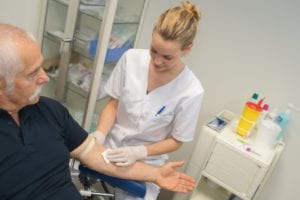
lung cancer blood test and mesothelioma survival

Mesothelioma patients and their doctors may have reason to be optimistic about a new lung cancer blood test.

A random trial of more than 12,000 high-risk people in Scotland shows the EarlyCDT test combined with CT imaging can detect cancer early. Earlier diagnosis is likely to lead to longer survival of lung cancers like pleural mesothelioma.

Researchers presented their findings on the new lung cancer blood test at a global conference this week in Spain.

Largest Lung Cancer Trial

As in the US, lung cancer is the biggest cancer killer in Scotland. Pleural mesothelioma is a form of lung cancer. Although it is rare, mesothelioma is more common in the UK than in other parts of the world. This is likely due to the area’s high use of asbestos after World War II. As with lung cancer, smoking raises the risk for mesothelioma.

The new trial included current and former smokers from Glasgow, Lanarkshire and Tayside. Trial participants were between 50 and 75 and at risk for developing cancer in the next 2 years. 

Patients were randomly assigned to get the new EarlyCDT while others got standard care. If a patient had a positive lung cancer blood test, they had chest X-rays and CT scans. They had follow-up scans every six months if the first one showed no cancer. 

According to a BBC report, the trial may be the largest of its kind in the world.

EarlyCDT Looks for Immune System Antibodies

Cancer triggers an immune response in the body. The immune response produces certain antibodies. The new lung cancer blood test looks for these antibodies to detect early cancer. 

In the EarlyCDT group, 15 percent more people who developed lung cancer were diagnosed at an early stage. The trial also showed these people were also less likely to die of their disease. 

Chief investigator Frank Sullivan, a professor at the University of St. Andrews, says these are “landmark findings” and likely to have “globally significant implications”. Those implications could extend to thousands of pleural mesothelioma patients around the world. 

Longer Mesothelioma Survival May Hinge on a Lung Cancer Blood Test

Right now, there is no way to detect pleural mesothelioma before symptoms develop. By the time a patient develops symptoms of mesothelioma, the disease is usually advanced. 

At an advanced stage, mesothelioma resists most standard treatments. Many mesothelioma patients die of the disease within 18 months of diagnosis. 

A lung cancer blood test like EarlyCDT could change that. Smaller mesothelioma tumors are more likely to be operable. A smaller tumor may also be more responsive to treatments like chemotherapy. 

A company called Oncimmune developed EarlyCDT. The CEO of Oncimmune, Adam Hill, says the company wants to “build the leading immunodiagnostic platform in the field of oncology.”

Researchers presented their findings at the World Conference on Lung Cancer in Barcelona earlier this week. 

Source: 

“Scottish Study Demonstrates that Autoantibody Test Followed by CR Imaging May Reduce Lung Cancer Mortality”, September 9, 2019, International Association for the Study of Lung Cancer presentation, New Release,https://wclc2019.iaslc.org/wp-content/uploads/2019/09/ECLS-Scottish-news-release_SSfs-8-16bbedits.pdf


Similar Posts

  • |

    Mesothelioma Still Rising Despite Ban in Ireland

    A study in Ireland confirms that it can take many years for a ban on asbestos to have a measurable impact on a country’s rates of malignant mesothelioma. Mesothelioma is the most serious of a list of diseases – including lung cancer, pleural plaques, asbestosis, and others – linked with exposure to asbestos dust. Affecting the linings around the lungs and other organs, mesothelioma is often resistant to most cancer treatments and may be fatal within a year of diagnosis. According to the International Ban Asbestos Secretariat, Ireland is one of 55 countries that have enacted some type of asbestos ban. However, although Ireland banned asbestos in 2000, a new study published in Cancer Epidemiology shows that incidence of the…

  • |

    Website Aims to Protect Homeowners from Mesothelioma

    Australia’s Cancer Council is trying to educate home renovators about their risk for mesothelioma with a new e-learning course. Australia has one of the highest per capita rates of mesothelioma in the world, largely because of several asbestos mining operations that were once located there. Although asbestos has been banned from building products in Australia since 1989, asbestos-linked diseases like mesothelioma, lung cancer, and asbestosis continue to pose a serious health concern. While mesothelioma has traditionally occurred among people exposed to asbestos on the job, Australia is now bracing for another “wave” of mesothelioma victims among homeowners who encounter asbestos while doing their own renovation projects. Cancer Council Australia has launched “kNOw asbestos in your home” in an effort to…

  • |

    Ape Virus Shrinks Mesothelioma Tumors in Lab

    A virus that causes leukemia in gibbon apes may have the power to help fight malignant mesothelioma in people. Gibbon ape leukemia virus (GALV) has been tested for years as a viral vector, a carrier of therapeutic genetic information, in the treatment of various human illnesses, including cancer. A new study in Japan compared GALV with a leukemia virus derived from mice to see which carrier communicated most efficiently with mesothelioma cells. While both types of viruses replicated in most of the mesothelioma cell lines tested, the mouse-derived virus was not effective in a mesothelioma cell line called ACC-MESO-1. In this cell line, only the GALV spread efficiently both in culture and in mice that had been given human mesothelioma…

  • | | |

    Mesothelioma Nurses Ready for New Cases in Australia

    Australia is bracing for an expected new wave of mesothelioma cases in the next decade and the Lung Foundation of Australia is taking action now to get ready. The Foundation has paid for ten nurses from around the country to receive specialized training in helping patients and families cope with mesothelioma. The nurses, who have recently completed the training, are now equipped to lead treatment planning for these complex cancer patients and to help other nurses do the same. Pleural mesothelioma is an aggressive cancer that occurs in the lining around the lungs. It is caused by exposure to asbestos dust, a toxin that was once alarmingly prevalent in Australia where it was mined and heavily used in construction. Because…

  • |

    Mesothelioma Blood Test May Be Possible

    An international team of researchers is studying the proteins found on the surface of cancer cells in an effort to improve mesothelioma diagnosis. The team, made up of scientists from the US, Switzerland, Italy and Chile, has just published their findings on a new kind of test to identify protein-derived mesothelioma biomarkers in blood serum. Mesothelioma is an aggressive cancer of the membranes around organs. Because the most common mesothelioma biomarker, mesothelin, is also overproduced by other kinds of cancer cells, it has only limited diagnostic value. A test to identify a set of proteins produced specifically by mesothelioma cells could greatly improve diagnostic accuracy. Led by Ferdinando Cerciello and Bernd Wollscheid of the Institute of Molecular Systems Biology in…

  • | |

    Spanish Mesothelioma Deaths Likely to Continue for Decades

    New research in Spain suggests that mesothelioma deaths will continue in the country until the “last surviving member” of the group of people exposed to occupational asbestos succumbs to the disease. Like many countries, Spain used asbestos heavily in the first half of the 20th century, especially in construction, where the mineral was prized for its durability, low cost, and resistance to fire and corrosion.  Asbestos was banned in Spain in 2002. Observing that more than 2.5 million metric tons of asbestos were imported into Spain from 1906 to 2002, researchers say deaths from mesothelioma have risen steadily. Between 1976 and 1980, a total of 491 Spanish people died of mesothelioma. By the 5-year period from 2006 to 2010, that…